TL;DR
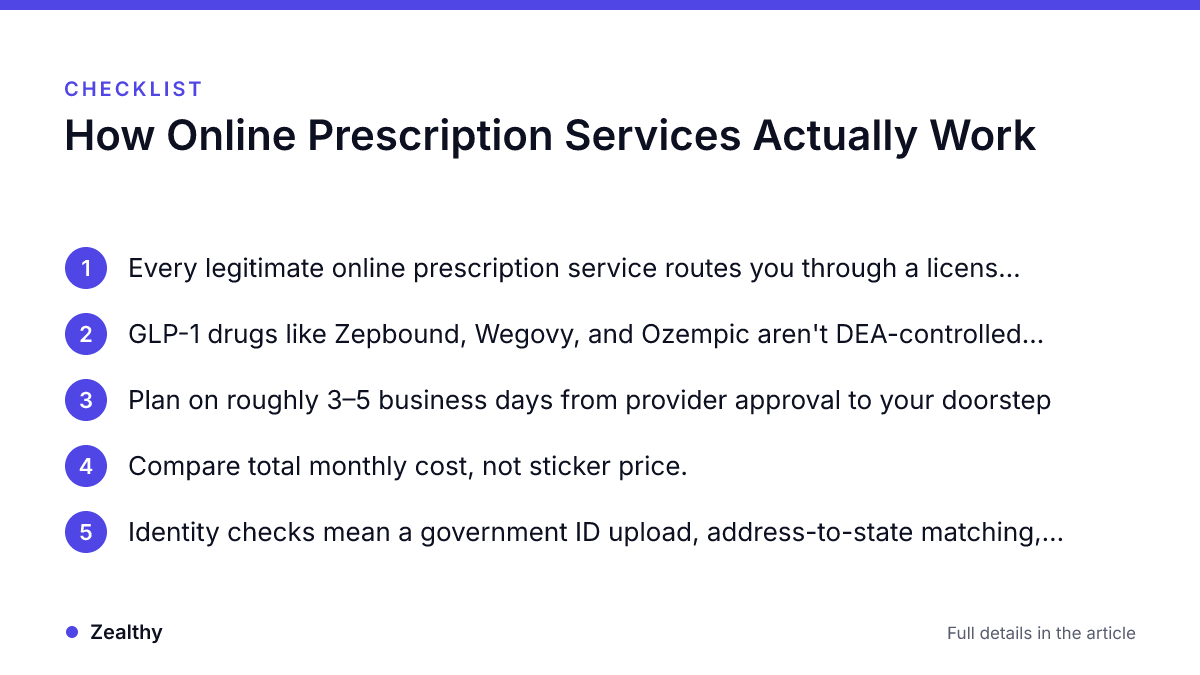
- Every legitimate online prescription service routes you through a licensed clinician first. No medical review, no prescription.
- GLP-1 drugs like Zepbound, Wegovy, and Ozempic aren't DEA-controlled substances, so a telehealth provider can prescribe them after one visit. True controlled substances like Adderall and Xanax generally require a live audio-video visit under federal telemedicine rules.
- Plan on roughly 3–5 business days from provider approval to your doorstep for standard shipping, with paid expedited options usually landing in 1–2.
- Compare total monthly cost, not sticker price. Medication + visit costs + your time is the number that actually matters, and we show the arithmetic below.
- Identity checks mean a government ID upload, address-to-state matching, and a full intake form read by a clinician licensed where you live.
A prescription service is any pharmacy, telehealth platform, or mail-order program that gets prescribed medication to you without a trip to a pharmacy counter for every fill. The good ones pair you with a US-licensed provider online, then ship the medication to your door with refills already scheduled. GLP-1 weight loss drugs, birth control, prescription acne cream, mental health medication. Same basic pipeline.
Table of Contents
- How do telehealth services handle controlled substances and GLP-1 medications?
- Can I get a prescription without ever talking to a doctor?
- How long does prescription delivery actually take?
- Is online prescription care actually cheaper than a pharmacy visit?
- Which online prescription service should I choose?
- How do these services verify who you are before shipping medication?
- Frequently asked questions
How do telehealth services handle controlled substances and GLP-1 medications?
Differently, and the reason is legal, not medical.
GLP-1 medications carry no DEA schedule. That's exactly why telehealth moved so fast in this category. A licensed provider can review your history, order labs if something looks off, and write the prescription after a single visit, the same way they'd handle a statin or blood pressure medication.
Controlled substances are another animal. Federal telemedicine rules generally require a synchronous audio-video visit before a provider prescribes Adderall, Xanax, or most opioids, and several states add their own requirements on top, including in-person exams within a set window. That's why intake processes look so wildly different from site to site. A focused questionnaire plus clinician review clears a non-controlled prescription. A controlled substance triggers a much heavier compliance load on the prescriber's side, including prescription drug monitoring program checks before anything is sent.
Legitimate mail-order pharmacies treat both categories like a chain would: verify the prescriber's license, check the state board, flag patterns that look like doctor-shopping before a box ever leaves the building.
Pro tip: if a site offers you a controlled substance after a checkbox form and zero clinician contact, close the tab. Real telehealth providers, including the ones behind reputable online pharmacies, don't cut that corner, because losing a medical license costs far more than one order is worth.
Can I get a prescription without ever talking to a doctor?
Not from a legitimate service. But "talking to" doesn't have to mean a live video call.
Asynchronous platforms still require a licensed clinician to read your answers, look at your photos, and check your history before approving anything. The visit just isn't happening in real time on camera. Retail pharmacies can't write you a brand-new prescription on the spot either, outside a narrow set of state-specific exceptions. Some states let pharmacists prescribe birth control, naloxone, or travel vaccines directly. That's a short list, not a general rule.
A website promising a prescription with no clinical review whatsoever isn't offering a shortcut. It's usually not a pharmacy at all.
How long does prescription delivery actually take?
In our experience, most telehealth prescriptions arrive 3–5 business days after a provider approves the plan, with expedited shipping cutting that to a day or two for an added fee.
| Shipping method | Typical timeframe | Best for |
|---|---|---|
| Standard mail-order | 3–5 business days | Routine refills, maintenance meds |
| Expedited/overnight | 1–2 business days (extra fee) | New starts, running low, travel |
| In-person pharmacy pickup | Same day, if in stock | Urgent needs, controlled substances requiring signature |
One detail nobody mentions until you've been burned by it: refrigerated medications, GLP-1 pens included, ship with cold packs in insulated mailers, and good pharmacies avoid dispatching them on a Friday so the package doesn't sit in a warehouse over a weekend. If your approval lands on a Thursday afternoon, expect a Monday ship date. That's a feature, not a delay.
The real scheduling trick is requesting your refill when you have about ten days of medication left. Do that and shipping speed stops mattering at all.
Compare any of this to a walk-in visit at a busy CVS pharmacy or a Saturday-afternoon Walgreens line. For anything you take every month, mail order usually wins. Our breakdown of why CVS pharmacy waits cost you refill days covers how those in-store delays stack up across a year of monthly refills.
Is online prescription care actually cheaper than a pharmacy visit?
Depends on the drug and your coverage. Here's how to run your own numbers instead of guessing.
The formula in plain words: monthly medication cost + (one-time visit cost ÷ months of treatment) + (hours spent per refill × what your hour is worth) = your true monthly cost.
Now a fully illustrative scenario, not a quoted price. Say a brand-name medication costs $1,000 cash for a 30-day supply at a retail counter, you need a $150 urgent-care visit to get the script because your PCP is booked six weeks out, you plan to be on it six months, and each pharmacy round trip eats 1.5 hours of your time, which you value at $30 an hour.
Retail route: $1,000 + ($150 ÷ 6 = $25) + (1.5 × $30 = $45) = $1,070 per month.
Now the telehealth version of the same scenario: $1,000 for the medication, a $45 flat monthly fee that covers the provider visit and follow-ups, zero drive time.
Telehealth route: $1,000 + $45 + $0 = $1,045 per month. Roughly $150 saved over six months, plus nine hours of your life back.
Rerun it with your actual numbers. The rule of thumb we'd give anyone: if your medication needs monthly refills and each trip costs you more than an hour, mail order almost always comes out ahead. If you fill one cheap generic every 90 days and the pharmacy is on your commute, it probably doesn't.
Insured? Run the same math against your real copay, and add a line for prior authorization. A two-week PA delay on a medication you've already started is the hidden cost nobody prints on a price sheet. Our comparison of Walgreens pharmacy versus online care applies a similar side-by-side to a specific chain.
| Cost factor | Retail pharmacy visit | Telehealth prescription service |
|---|---|---|
| New patient visit | Separate doctor's appointment and copay | Included in intake, usually one flat fee |
| Refill process | In person or by phone, then wait for the pharmacist | Automatic, scheduled shipments |
| Time cost | Drive time, wait time, repeat trips when stock is out | Handled online in minutes |
| Consultation fee | Sometimes charged for new scripts | Typically bundled into the plan |
| Ongoing support | Rare unless you book another visit | Coaching or follow-up check-ins included |
Which online prescription service should I choose?
Whichever one licenses providers in your state, prices things plainly, and is still answering messages three months after your first shipment. That last part eliminates more companies than you'd think.
Check these before your credit card comes out:
- Providers licensed in your state specifically. Not an offshore call center, and not one clinician somehow covering all fifty states.
- A real medical intake. If you can't imagine any answer getting you declined, it isn't a screening, it's a sales funnel.
- Pricing that survives month four. Ask what the rate becomes after the introductory period ends. Introductory pricing that triples on renewal is the most common complaint we hear about competitors.
- Automatic refills you can pause or cancel from the app. Any service that routes cancellation through a phone call during business hours designed it that way on purpose.
- Follow-up access to your provider. Side effects show up in week three, not week one. You need someone to message then.
- A named, verifiable pharmacy. You should be able to find the dispensing pharmacy's name and confirm its licensing, not just a brand logo.
Zealthy builds its weight loss and hair loss programs around that checklist. Our rundown of the best telehealth providers in the United States compares how several major platforms handle each point. Shopping men's health or hair-specific options outside our catalog? Plenty of smaller telehealth brands do good work in their own niches. Just run each one through the same six checks before you hand over a card number.
How do these services verify who you are before shipping medication?
Identity and medical fit both get confirmed before anything ships. That verification step is the line between a licensed pharmacy operation and a website selling pills.
The standard sequence: a government-issued ID upload, a shipping address checked against the state you say you're in (providers can only prescribe where they're licensed), and a full intake covering health history, current medications, and allergies. A licensed clinician reads it. Some services add a photo or short video check when something in your history warrants a closer look.
That review is also where interactions and contraindications get caught, which is the whole reason a human sits in the loop. Mail-order operators like Postal Prescription Services describe a comparable verify-then-dispense structure. It's roughly the industry standard for shipping FDA-regulated medication across state lines.
Pro tip: keep your address and state selection current in your patient portal. A mismatch between the two is the single most common reason a legitimate shipment gets held, and it's fixed in about thirty seconds once you know to look.
Ready to see the whole thing end to end? Start with a five-minute intake at Zealthy, pick your care (weight loss, ED, birth control, skincare, or mental health support), and a licensed provider takes it from there.
Frequently asked questions
Can I use my insurance with an online prescription service?
Many platforms accept insurance for the visit, the medication, or both. Coverage varies by plan and by drug, and GLP-1 coverage in particular comes down to your insurer's formulary. Check the service's FAQ or ask support directly before you start, and have your member ID handy so they can give you a real answer instead of a maybe.
What happens if I need to change my dosage after my prescription ships?
Go back into the platform and request a follow-up or message your provider. Most services build this in without charging another visit fee, because dose titration is expected with GLP-1 medications during the first few months.
Is it safe to get a prescription from a website I've never heard of?
Only if you can verify two things: the provider is US-licensed, and the pharmacy filling the order is a real licensed pharmacy. Look for a physical business address, a named medical team, and state-by-state licensing details. If any of the three is missing, don't enter payment information.


.svg)
.svg)
.svg)
.svg)

