TL;DR
- MedVi's compounded semaglutide runs $179 for the first month and $299 for refills, while name-brand Ozempic or Wegovy through the same platform costs $795 the first month and $995 monthly after, per Woman's World.
- Brand-name pathways carry a separate $99 monthly membership fee on top of medication costs, according to PeptidePub's review.
- Cancel at least 72 hours before your next billing date or you'll be charged again. MedVi states this plainly in its terms, per CliniqGuide.
- MedVi received an FDA warning letter in February 2026 over labeling and claims for its compounded semaglutide and tirzepatide, which should change how much weight you give "doctor-led" marketing language.
- Compounded medications aren't FDA-approved the way Ozempic or Zepbound are. MedVi says so itself.
Here's the pattern we hear from people who switch to us, stitched into one composite story. Call her Dana. She found MedVi through an Instagram ad promising "compounded semaglutide starting at $116." The health questionnaire took her a few minutes, in line with the under-five-minute intake Woman's World describes. She paid at checkout. Two days later an email arrived to schedule her virtual consult, and her medication showed up about nine days after that.
So far, normal.
The surprise landed in month two, when her refill billed at $299 instead of the $179 she'd paid upfront. She'd never read what happens after the intro price expires.
That's the whole story of most MedVi reviews. The entry price is real. The ongoing cost, and the fine print wrapped around it, is where the confusion lives.

Table of Contents
- What is the monthly cost of MEDVi?
- How much does MedVi actually cost over six months?
- What do MedVi reviews say about compounded versus name-brand medication?
- Does insurance cover MedVi's GLP-1 program?
- How fast does MedVi ship, and what happens if something goes wrong?
- Is MedVi legit, and what's a steadier alternative?
- Your next step
- Frequently asked questions
What is the monthly cost of MEDVi?
It depends entirely on which medication pathway you pick, and the gap between the cheapest and priciest option is enormous.
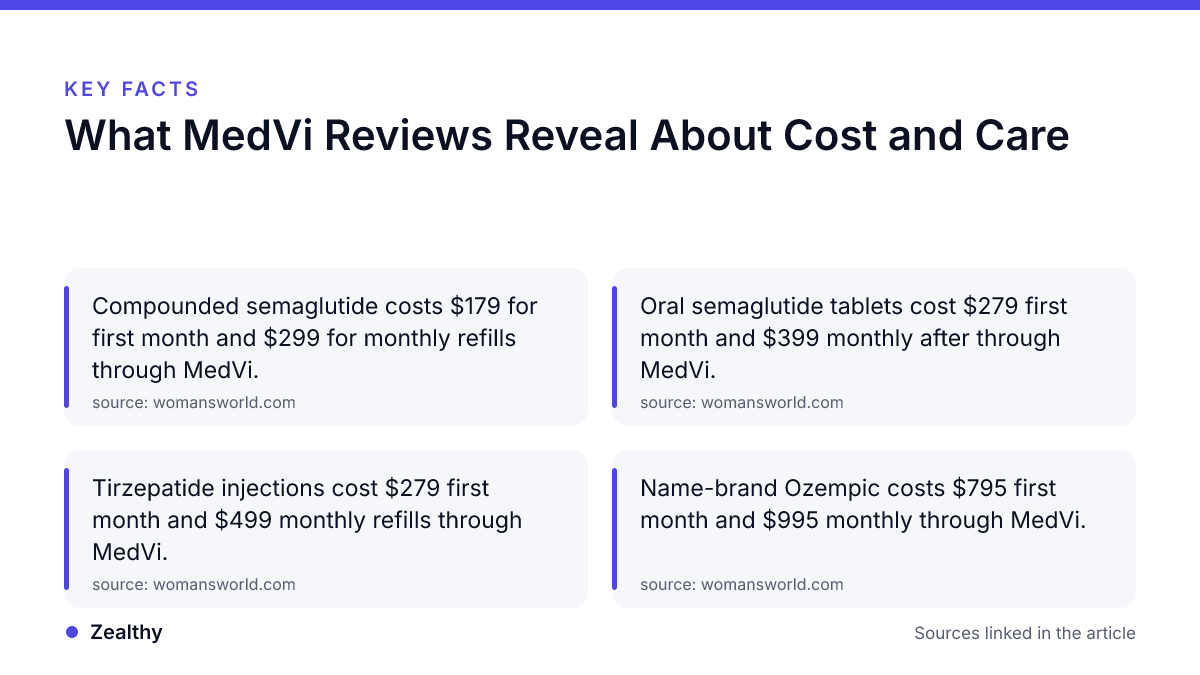
Compounded semaglutide costs $179 for the first month and $299 for every refill after. Oral semaglutide tablets run $279 initially, then $399 monthly. Compounded tirzepatide injections start at $279 and climb to $499 for refills. Name-brand Ozempic and Wegovy both list at $795 for month one and $995 every month after, and that's before the $99 monthly membership fee MedVi charges on the brand-name Wegovy and Zepbound pathways, according to PeptidePub's breakdown.
Some MedVi landing pages have advertised lower entry prices still: compounded semaglutide from $116 and tirzepatide from $166, per CliniqGuide. The number in the ad is not always the number on the checkout page by the time you get there.
| Medication path | First month | Monthly refill | Extra fees |
|---|---|---|---|
| Compounded semaglutide | $179 | $299 | None disclosed |
| Oral semaglutide tablets | $279 | $399 | None disclosed |
| Compounded tirzepatide | $279 | $499 | None disclosed |
| Name-brand Ozempic/Wegovy | $795 | $995 | $99/mo membership fee |
Pro tip: Screenshot your cart page before you check out, with the price and the date visible. If you later need to dispute a charge with your card issuer, a screenshot of the quoted price beats a description of an ad you can no longer find.
How much does MedVi actually cost over six months?
Run this math before you commit to any GLP-1 subscription, MedVi or otherwise. The formula is simple: first-month price plus five refills.
Compounded semaglutide: 179 + (5 × 299) = 179 + 1,495 = $1,674 for six months.
Name-brand Ozempic or Wegovy: 795 + (5 × 995) = 795 + 4,975 = $5,770 for six months. Add the membership fee at $99 × 6 = $594, and you land at $6,364.
That's roughly 3.8 times the compounded cost for the same six months. Plug your own numbers in and you get a real threshold to decide against: if the difference between paths is more than about $500 a month, the question stops being "which is cheaper" and starts being "what am I actually buying with that money." Which brings us to the next part.
What do MedVi reviews say about compounded versus name-brand medication?
Compounded semaglutide and tirzepatide are not the same product, legally or chemically, as the brand versions from Novo Nordisk and Eli Lilly. MedVi states directly that its compounded medications are not FDA-approved and that the company doesn't manufacture them, sourcing instead through a compounding pharmacy, per CliniqGuide's review.
Three things follow from that:
- Dosing consistency varies more with compounded formulations than with mass-manufactured pens. A compounded vial comes with a syringe and a units-per-dose instruction, so you're measuring your own dose. A brand pen clicks to a fixed dose. We see more dosing errors from the first setup than the second, especially during titration weeks.
- Side effect reporting is harder to track across compounded products, because no single manufacturer is collecting adverse event data the way Novo Nordisk and Lilly do for their approved drugs. If your nausea is unusual, there's no large dataset to compare it against.
- Regulatory oversight tightened in February 2026, when MedVi received an FDA warning letter concerning its claims and labeling for compounded semaglutide and tirzepatide, per PeptidePub. That's not a recall. It is a reason to read phrases like "doctor-formulated" and "pharmacy-grade" as marketing rather than regulatory status.
My honest take: compounded medication can be a reasonable bridge for someone with no coverage and no path to the brand drug. It's a poor choice for someone who could get the approved version covered and is just avoiding the paperwork. Our breakdown of semaglutide for weight loss walks through how the approved medication works if you want a side-by-side read before choosing.
Does insurance cover MedVi's GLP-1 program?
MedVi's advertised pricing is cash-pay. The model is built for people without GLP-1 coverage, or people who'd rather skip prior authorization entirely. That's also why the compounded tiers exist: insurers generally won't reimburse compounded semaglutide or tirzepatide at all, while they sometimes will cover brand-name Ozempic, Wegovy, or Zepbound.
So before you enroll anywhere, call the member services number on the back of your card and ask three specific questions:
- "Is semaglutide or tirzepatide covered under my pharmacy benefit for weight management, or only for type 2 diabetes?" Plans routinely cover one and exclude the other, and the rep will often answer "yes, it's covered" without that distinction unless you force it.
- "What's the name of the prior authorization form, and what does it require?" Get it in writing so your prescriber submits the right documentation the first time.
- "What's my copay or coinsurance after approval?" Coinsurance of 30% on a drug with a four-figure list price is not the same as a flat copay.
Here's why the answer matters financially. Say your plan approves Wegovy at a $50 monthly copay. Six months costs you 6 × 50 = $300. The cash brand pathway priced above runs $6,364 over the same six months. Even if the prior authorization takes three frustrating weeks and a denial appeal, that's a rate of return on paperwork most people won't find anywhere else.
Our GLP-1 weight loss program works with patients whether or not they have insurance, which is worth comparing line by line against a cash-only model before you commit to a year of refills.
How fast does MedVi ship, and what happens if something goes wrong?
MedVi emails within 24 to 48 hours of checkout to schedule your virtual consultation, and medication typically ships within 7 to 10 business days, per Woman's World. Shipping is advertised as free on every order, included in program pricing.
That timeline is fine. It also only describes your first fill.
The friction people describe to us almost always starts later: slow email responses when a refill runs late, uncertainty about how to pause instead of cancel, and the hard 72-hour cancellation window. MedVi requires a cancellation request to land at least 72 hours before your next billing date, according to CliniqGuide. Miss it and you're billed for another month whether you wanted the medication or not.
Pro tip: Set a calendar reminder five days before your billing date, not one. Support queues back up around the first of the month, and submit your cancellation in writing through whatever channel generates a timestamped confirmation. "I emailed them" is a weak position in a chargeback dispute. A confirmation number with a date on it is a strong one.
Is MedVi legit, and what's a steadier alternative?
MedVi is a real telehealth company with licensed providers. It isn't a scam. But "legit" and "predictable" are different standards, and the gap between them is what most MedVi reviews are really describing.
Four things stack up: pricing that shifts between landing pages and checkout, a membership fee layered onto brand-name drugs, a strict cancellation window, and the February 2026 FDA warning letter. None of those is disqualifying on its own. Together they describe a company that's cheap to start and murky to stay with.
If you've read enough MedVi tirzepatide reviews and QUAD by MedVi reviews to feel uneasy about the fine print, that instinct is worth acting on. At Zealthy, sign-up takes about five minutes, a licensed provider builds your plan on a real visit, and refills run automatically without a separate membership tier. You can see current options on our weight-loss page or read how Ozempic compares to Mounjaro if you're still deciding which medication fits. And if your frustration is less about GLP-1s and more about how long any pharmacy makes you wait for a routine refill, our piece on why CVS pharmacy waits cost you refill days explains where that bottleneck comes from.
Shopping beyond weight loss, maybe for a men's health concern or just a second platform to price against? Pull up two or three other telehealth brands that treat the condition you're actually asking about, line their refill prices and cancellation terms up next to MedVi's and ours, and decide from the comparison instead of clicking the first ad you see.
Your next step
Write down three numbers before you enroll anywhere: the price quoted today, the price on refill two, and the cancellation deadline. If a company makes any of those hard to find before checkout, that tells you more than any star rating will. Then check the provider's refund policy and cancellation terms before your card number goes anywhere.
Frequently asked questions
Can I switch from MedVi to a different telehealth provider mid-prescription?
Yes, but time it around your billing cycle. Cancel with at least 72 hours' notice before your next charge, then start the new provider's intake. Most telehealth sign-ups, including ours, take under five minutes and don't require you to finish an existing contract. Keep whatever medication you've already paid for and use it while the new prescription processes.
Does MedVi treat anything besides weight loss?
Its marketing centers on GLP-1 weight loss medication, though the broader platform has advertised ED treatment too, which is why searches like "MedVi ED reviews Reddit" exist. Pricing and structure for non-weight-loss treatments aren't published in the same detail as the GLP-1 program, so confirm specifics directly rather than assuming the same pricing logic carries over.
What should I do if MedVi charges me after I thought I canceled?
Start with MedVi support and give them a short, documented window to resolve it. If they don't, dispute the charge with your card issuer and submit your cancellation timestamp alongside the billing date. Going forward, check a company's stated customer service contact options before you sign up rather than during a disputed charge.


