TL;DR
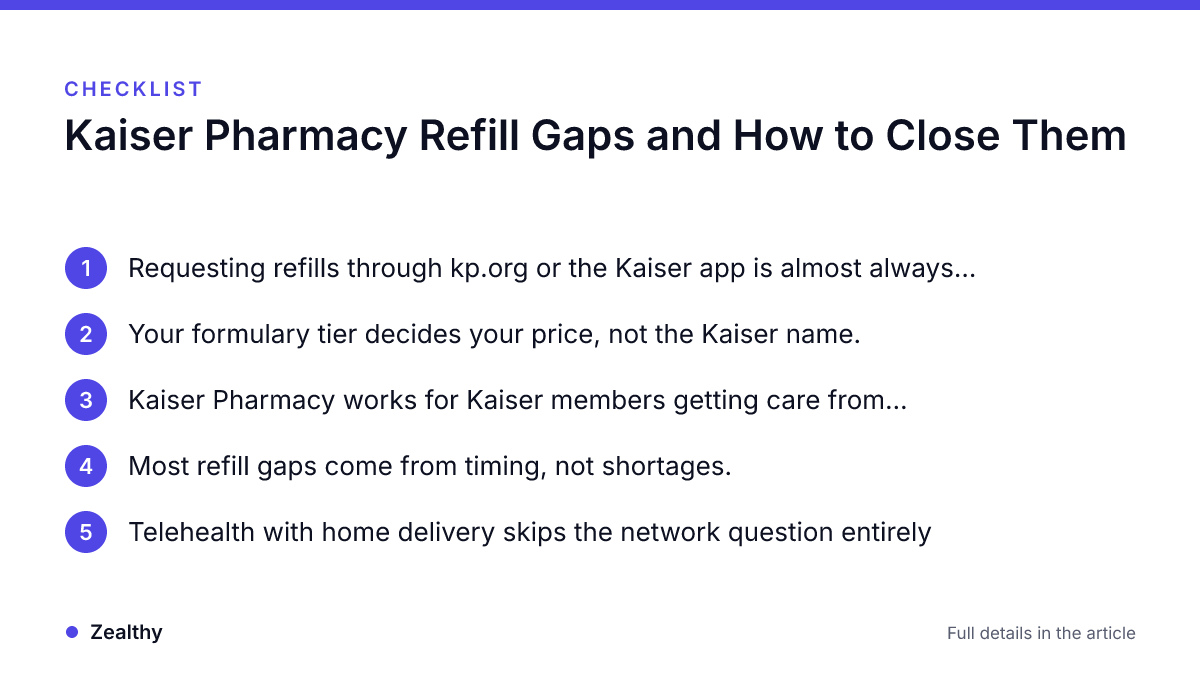
- Requesting refills through kp.org or the Kaiser app is almost always faster than calling in or walking up to the counter. Phone and walk-in requests land in the same queue as everyone else's.
- Your formulary tier decides your price, not the Kaiser name. A GLP-1 like Zepbound or Wegovy often sits in a specialty tier with percentage coinsurance instead of a flat copay, which changes the number dramatically.
- Kaiser Pharmacy works for Kaiser members getting care from Kaiser-affiliated providers. An outside prescription usually can't just be handed across a Kaiser counter the way it can at CVS or Walgreens.
- Most refill gaps come from timing, not shortages. Insurance "refill too soon" rejections, 90-day supply math, and prior authorization renewals cause more missed doses than empty shelves do.
- Telehealth with home delivery skips the network question entirely if you want refills that don't depend on one health system's pharmacy hours.
You're standing at the counter, you planned ahead, and the tech tells you your refill "isn't ready yet." Maybe it's stuck in prior auth. Maybe the system says you're three days early. Either way, you're going home empty-handed.
Kaiser runs an integrated pharmacy, meaning your doctor, your chart, and your prescriptions all live in one system. That's genuinely useful. It also means every bottleneck is internal, and when one step stalls, there's no second pharmacy down the street holding the same script. Here's what actually drives your wait and your bill.

Table of Contents
- Does Kaiser Pharmacy refill prescriptions faster than CVS or Walgreens?
- Why does Kaiser say my refill is "too soon" when I'm nearly out?
- Is Kaiser Pharmacy actually cheaper for GLP-1s and other medications?
- Does Kaiser's formulary cover what telehealth providers commonly prescribe?
- What do you do when Kaiser Pharmacy isn't an option?
- Frequently asked questions
Does Kaiser Pharmacy refill prescriptions faster than CVS or Walgreens?
It depends entirely on which channel you use. A refill requested through the app days ahead of time usually beats a retail counter run. A refill requested at the counter competes with the same staffing and stocking limits that slow down any CVS pharmacy or Walgreens location.
The "Kaiser is faster" belief usually comes from an unfair comparison: someone's smoothest mail-order experience stacked against their worst retail experience, which was probably a crowded counter at 5:40pm on a weekday. Compare channel to channel instead, Kaiser mail order against CVS mail order, Kaiser pickup against Walgreens pickup, and most of the gap disappears.
Here's how we tell patients to plan for each option:
| Refill method | Plan for | Best for |
|---|---|---|
| Kaiser mail order (kp.org/app) | About a week door to door, longer around holidays | Maintenance meds you've been on a while |
| Kaiser counter pickup | Same day if it's in stock, a day or two if it has to be ordered | Short-term scripts, antibiotics, anything urgent |
| CVS or Walgreens retail | Same day when stocked | Non-Kaiser members, plans with open pharmacy networks |
| Telehealth with home delivery (e.g., Zealthy) | A few days from visit to doorstep | New prescriptions and recurring auto-ship refills |
Pro tip: Build in 7 to 10 days of lead time on mail order and never less. Kaiser's own guidance on managing prescriptions points to the same thing: mail order needs runway. Treating it like a same-day pickup is the single most common way people end up rationing pills.
Why does Kaiser say my refill is "too soon" when I'm nearly out?
Because your insurance, not the pharmacy, controls the refill date, and it's calculated from the day supply on the label rather than from how many pills are actually in your bottle. Most plans won't pay until roughly three-quarters of the supply has been used.
Here's the math, and you can run it on your own prescription. Take your day supply, multiply by 0.75, and that's roughly the earliest day the claim will go through.
A 90-day supply filled on January 1:
90 × 0.75 = 67.5, so the refill clears around day 68, which is March 9.
Now subtract your shipping window. If mail order runs about a week door to door, request it on day 68 and expect it around day 75, which leaves you two weeks of pills as buffer. Request it on day 85 instead and you're cutting it to nothing.
That's the whole trick. Request on day 68, not day 85. If you've lost a bottle or you're traveling, call and ask for a vacation override before you leave, not after you've run out. Pharmacies can request them, but it takes a phone call to the plan and that call takes time.
Is Kaiser Pharmacy actually cheaper for GLP-1s and other medications?
Sometimes, and the savings come from your plan's tier structure rather than from Kaiser discounting anything. Generics usually sit in the lowest tier with a small flat copay. Brand names move up. Specialty medications, where GLP-1 weight loss drugs like Zepbound, Wegovy, and Ozempic commonly land, are frequently billed as coinsurance, meaning you pay a percentage of the drug's cost instead of a fixed dollar amount.
Illustrative scenario, not a Kaiser-quoted price: your plan puts a GLP-1 in a specialty tier at 25% coinsurance against a $1,000 monthly list price.
25% × $1,000 = $250 per month, and that's after you've met your deductible. Before you meet it, you may be paying the full negotiated price.
Swap in your own numbers. Your coinsurance percentage times the drug's cost is your monthly number. If that result is more than roughly $200 a month, it's worth pricing cash-pay and telehealth options side by side before you commit to a year of it.
"Kaiser Pharmacy cost" isn't one number. It's a function of:
- Tier placement for your exact drug and dose on your exact plan, which can shift at the start of a plan year
- Whether you've hit your deductible, which makes January and February the most expensive months of the year for specialty drugs
- Whether a generic or biosimilar exists that the formulary prefers over what you were prescribed
- Whether prior authorization is required, which costs you time even when the price is fine
Pro tip: Pull up the drug in your plan portal and look for two things: the tier number and the word "coinsurance." If you see a percentage instead of a dollar sign, your cost is tied to the drug's price and will move. If you see a flat dollar copay, your cost is fixed no matter what the list price does.
Does Kaiser's formulary cover what telehealth providers commonly prescribe?
Broadly yes by category, but coverage varies drug by drug inside each one. Generic birth control, common SSRIs, and at least one GLP-1 option are typically on the formulary. Which specific brand, dose, and formulation is covered, and at what tier, changes by plan year and by region.
The part people underestimate is the paperwork. Prior authorization on a GLP-1 generally needs documentation in your chart, and that usually means a recorded height and weight, a diagnosis code that matches the drug's approved use, and in many cases a note about what you've already tried. If your chart is missing one of those pieces, the request gets denied and the clock restarts while someone re-submits it.
So the realistic sequence for a new GLP-1 start inside Kaiser is visit, then submission, then a decision window, then the fill. Each handoff adds days. The medication can be fully covered on paper and still be three or four weeks out.
That matters most when timing isn't flexible. Starting PrEP before a trip. Beginning a new birth control pack before the current one ends. Refilling an antidepressant you can't taper off safely. "It's covered" and "it's in your hand Thursday" are different facts.
What do you do when Kaiser Pharmacy isn't an option?
Telehealth providers can prescribe and ship most of these same medication categories without any Kaiser membership. That's the practical answer for people between plans, people whose plan won't cover a specific drug, and people who can't make a weekday pharmacy window work.
Where this comes up most:
- You moved, and the new facility has a long new-patient wait. A virtual visit doesn't care about your ZIP code or your assigned clinic.
- Your prior authorization was denied and you're appealing. Appeals take weeks. Many telehealth platforms, including Zealthy, offer GLP-1 care with coaching while that plays out.
- You need something sensitive handled discreetly. PrEP, ED treatment, and mental health medication can run visit to prescription to delivery in one flow, without a waiting room.
If you're weighing options generally, our breakdown of how online prescription services actually work walks through what happens between the visit and the box on your porch. When a local pharmacy keeps coming up empty instead, Giant Eagle Pharmacy out-of-stock situations and our guide for no 24-hour pharmacy nearby use the same workaround logic.
For weight loss specifically, TWL telehealth runs same-day video visits with coaching built into the GLP-1 plan and ships to your door. For needs outside the weight-loss lane, look for a licensed platform that covers your specific category and ships to your state.
Pro tip: Switching pharmacies mid-prescription? Ask the receiving side exactly what they need from the old one before you cancel anything, and keep at least two weeks of medication on hand while the transfer completes. Our guide on transferring prescriptions from Safeway Pharmacy lists the right questions, and they apply whether you're leaving Kaiser, CVS, or Walgreens.
Frequently asked questions
What's the Kaiser Pharmacy phone number if I need to reach someone directly?
There isn't one national pharmacy line. The number is specific to your region and your assigned facility, and you'll find it on your member ID card and in your kp.org account under your pharmacy location. General member services can route you if you can't locate it.
Are Kaiser Pharmacy hours the same everywhere, including 24-hour access?
No. Hours vary a lot by facility, weekend coverage is usually shorter, and overnight access is rare. Check the specific location on kp.org rather than assuming it matches a nearby CVS pharmacy or Walgreens that does stay open late.
Can I refill a Kaiser prescription online without calling?
Yes. kp.org and the Kaiser app let you request refills, check mail-order status, and turn auto-refill on or off without picking up the phone. For maintenance medications it's the fastest path and the one least likely to strand you near your refill date.
Pull up your most recent prescription label right now and find the day supply. Multiply it by 0.75, count that many days from your fill date, and put a reminder on your calendar for that morning. That one number is the difference between a refill that shows up early and a week of skipped doses. If you've hit that wall more than once, compare Kaiser against the best telehealth providers for the medication you actually depend on.


.svg)
.svg)
.svg)
.svg)

